How many restrooms does a race in Menifee actually need?
Start with the crowd, not a guess. OSHA 1926.51(c) sets 1 toilet for 20 workers on a job site, and race organizers use that same math as a floor: more units per runner than a construction crew, because everyone hits the restroom in the same 20-minute window before the gun goes off. A 500-runner 10K in Menifee typically needs units clustered at the start/finish and at least one more stop near the halfway mark if the course loops through neighborhoods. Check how many porta potties do I need for the full breakdown by headcount. ADA Standards section 213.2 requires at least 5 percent of a clustered bank to be accessible, never fewer than one unit, so a 10-unit bank needs one ADA unit minimum. We carry both standard porta potty rental units and ADA accessible porta potty units for exactly this math. For races with a VIP tent or a sponsor area, a lot of Menifee organizers upgrade that zone to a deluxe flushable porta potty instead of standard units. If your race also needs a real restroom experience for staff or media, look at restroom trailer rental or the smaller 2 stall restroom trailer for a compact footprint near the finish line.
What does it cost to rent restrooms for a race in Menifee?
Race pricing runs by the event, not the day, because delivery, placement, and pickup all happen inside a tight window around your course schedule.
| unit type | typical range | notes |
|---|---|---|
| standard unit, event rate | $200 to $800 | covers full event day, per unit |
| ADA unit, per day | $200 to $400 | needed for accessible cluster |
| delivery fee | $100 to $500 | depends on course access points |
| service fee, event | $400 to $1,200 | weekend races often need weekend-tier service |
A single loop course near Canyon Lake, 5.9 miles west of central Menifee, costs less to service than a point-to-point course that needs two separate delivery drops. Full pricing detail lives on porta potty rental cost and porta potty rental per day if you want to compare against a single-day rental instead of an event package. Multi-day festivals or race weekends sometimes make more sense on a monthly porta potty rental if the units stay out for setup, race day, and breakdown across several weeks.
Do we need lighting or power at the start/finish line?
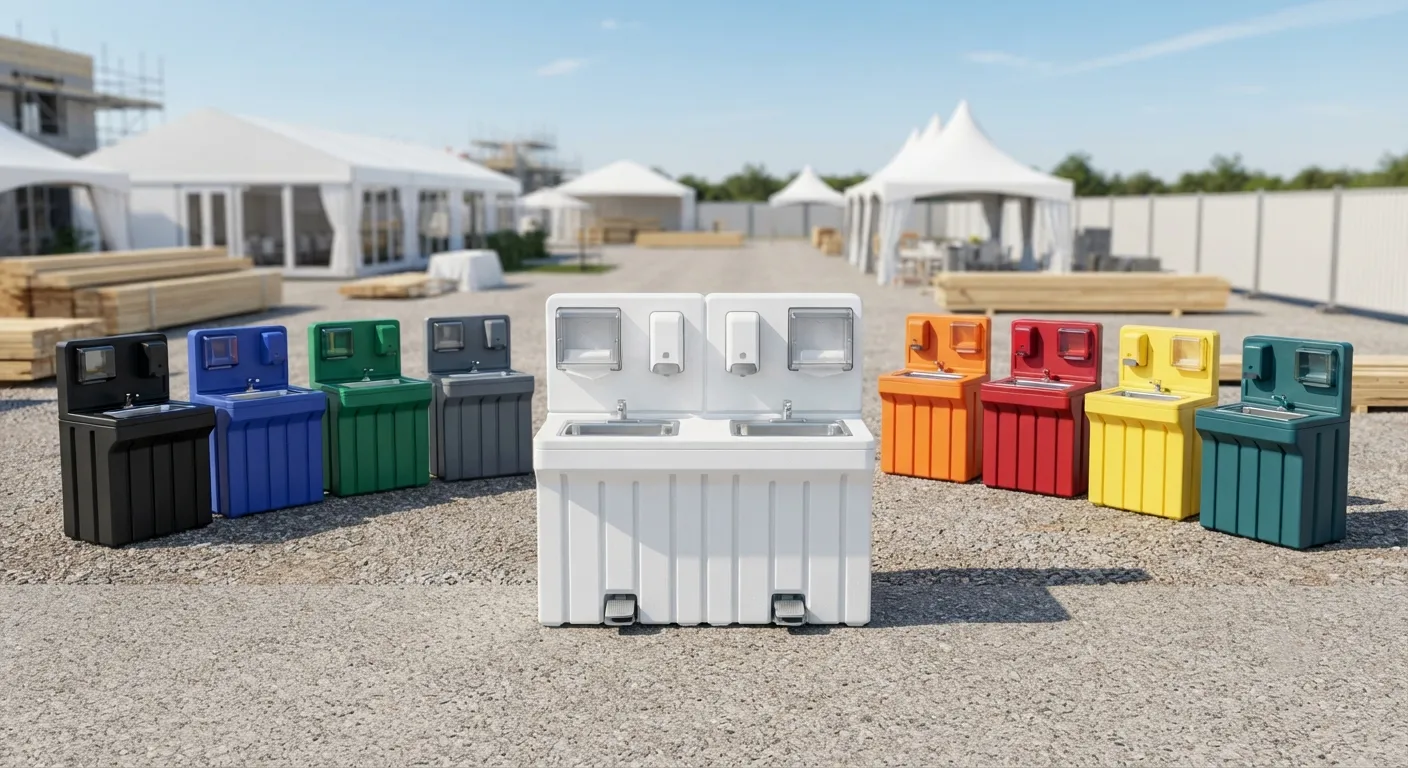
Most Menifee races starting before sunrise or running into dusk need a light tower rental at the start/finish arch and any aid station near unlit roads. OSHA 1926.56(a) sets minimum illumination intensities for work areas, and race organizers use the same baseline for safety at staging zones. If your finish line runs a timing system, announcer booth, or food vendors, you will likely need a temporary power pole rather than running extension cords across a public path. How to brace a temporary power pole matters here: the pole needs a stable base plate and guy-wire anchoring so wind or a stray runner cannot tip it, and GFCI protection under OSHA 1926.404(b)(1)(ii) is required anywhere the power feeds outdoor equipment near water stations or wash-down areas. Pair the power setup with a handwashing station rental at food and medical tents; 29 CFR 1910.141(d)(2) requires soap and a towel or hand-drying device at any handwashing station, not sanitizer alone. If your course includes an aid station with a grill or fryer, note that OSHA 1926.51(f)(1) washing requirements apply specifically to paint, coatings, herbicide, or insecticide exposure, not general food handling, so a standard handwash unit covers that need.
Courses that route through Wildomar, 10.2 miles southwest of Menifee, or Lake Elsinore, 11.0 miles west, sometimes split delivery across two drop points rather than trucking every unit to one staging lot. Talk through your course map with Menifee Porta Pros early so delivery trucks have the clearance they need. If the race needs waste removal too, a same-day roll-off dumpster rental at the finish line handles cups, banners, and vendor trash without a second truck visit. For races that draw a bigger crowd than a typical 10K, check festival restroom rental or concert restroom rental for layout ideas built around foot traffic patterns similar to a race course.
How far in advance should we book race restrooms?
Book as soon as your course map and headcount are set, ideally 4 to 6 weeks out for a race over 300 runners. Weekend races carry a premium service rate, so locking dates early protects your budget. See request a quote to start the layout conversation.
Can we place units directly on the race course?
Yes, at aid stations and the start/finish, but placement needs firm, level ground per ADA Standards section 302.1 if any unit is marked accessible. Review the porta potty placement guide before finalizing your course map.
Do race restrooms need to be serviced during a multi-day event?
Yes. ANSI/PSAI Z4.3 sets a baseline of one service visit per week for light use, but race weekends with heavy traffic need mid-event servicing. Ask about a service schedule when you book through Menifee Porta Pros.
What size crew justifies an ADA unit at a race?
Any cluster of portable units triggers ADA Standards section 213.2: at least 5 percent must be accessible, never fewer than one. Even a small race with 3 units needs one ADA-compliant unit in that bank.
Can we add handwashing stations without full restroom trailers?
Yes. A standalone portable sink rental or hand sanitizer station rental works well at aid stations where full trailers are not practical. Both pair easily with standard unit clusters along the course.
Next step
Get a delivery date
Tell us the address, the dates and the headcount. We size the order and confirm the route.